

Nothing like the Web has ever happened in all of human history. The scale of its impact and the rate of its adoption are unparalleled. This is a great opportunity as well as an obligation. If we are to ensure the Web benefits the human race we must first do our best to understand it.
The Web is the largest human information construct in history. The Web is transforming society. In order to understand what the Web is, engineer its future and ensure its social benefit we need a new interdisciplinary field that we call Web Science.
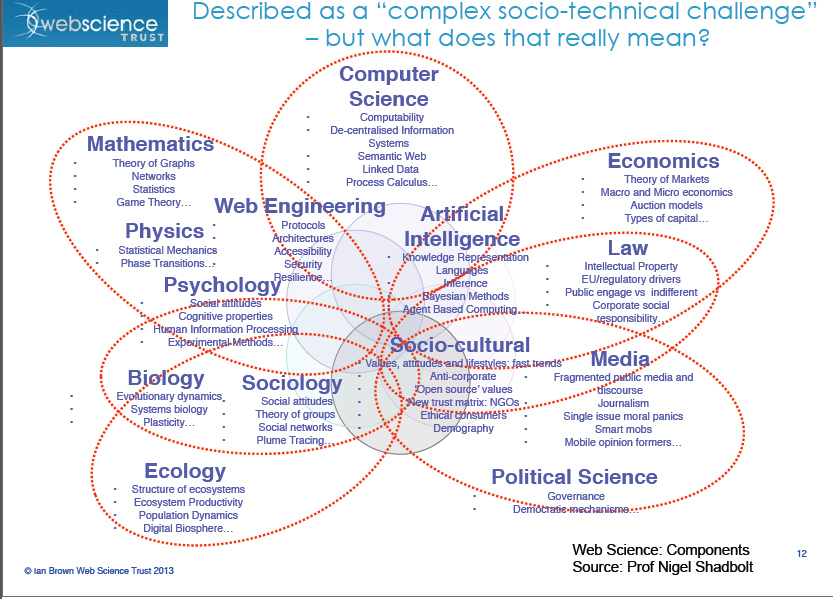
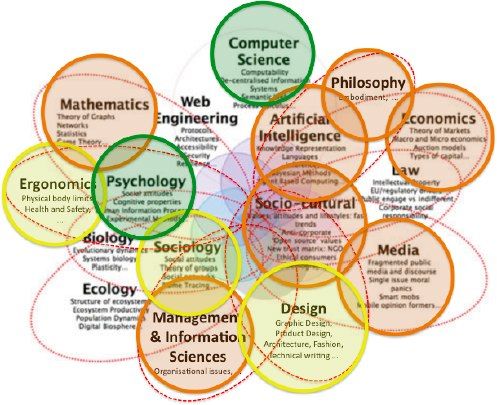
Web science is an emerging interdisciplinary field concerned with the study of large-scale socio-technical systems, particularly the World Wide Web. It considers the relationship between people and technology, the ways that society and technology co-constitute one another and the impact of this co-constitution on broader society. Web Science combines research from disciplines as diverse as sociology, computer science, economics, and mathematics.
An earlier definition was given by American computer scientist Ben Shneiderman: "Web Science" is processing the information available on the web in similar terms to those applied to natural environment.
The Web Science Institute describes Web Science as focusing "the analytical power of researchers from disciplines as diverse as mathematics, sociology, economics, psychology, law and computer science to understand and explain the Web. It is necessarily interdisciplinary – as much about social and organizational behaviour as about the underpinning technology."
Now in the world has around 20 popular educational organizations of Web Science programs, some of them below.